Unlike the old summer-vacation-centric model many regions follow, hotels across much of Asia are seeing that year-end isn’t just a lull, it’s becoming a meaningful booking period.
According to recent data, many markets in the region recorded increases in RevPAR (revenue per available room) during December, even though December is “traditionally the slowest month” for many hotels.
Several factors are driving this shift: increasing regional mobility, better air connectivity, more holiday and leisure travel, and growing guest expectations for experiences which means even “off-peak” months carry potential value.
For hotel decision-makers, that means Q4 (and “year end”) is no longer a “cleanup month”, it’s a strategic opportunity.
What the Data Is Showing? Key Patterns Across Asia
1. Mixed but Often Resilient – Rate & Occupancy Performance
- As of 2025, there’s significant divergence by segment: luxury and upper-upscale hotels are more resilient, while mid-market and economy-tier hotels face greater pressure.
- In H1 2025, some markets recorded strong ADR (average daily rate) growth, for example, Japan saw a ~17% increase.
- In other markets, ADR and occupancy remain under pressure, or growth has flattened.
Implication: “One-size-fits-all” pricing strategy don’t work anymore. Year-end planning must consider your market, competitive set, and hotel segment.
2. Shift Toward Premium / Upscale & Longer Stays
According to recent industry insights, more travellers especially in Asia are opting for “non-standard” or upgraded rooms (Superior or Luxury) rather than budget or standard rooms. This is especially noticeable in Asian source markets like China, Indonesia, and India.
Moreover, there’s a rising demand for longer stays or “extended stay” behavior, which opens opportunities for hotels to position mid-to-long stay offers, packages or discounts for guests staying more than just a weekend.
Implication: Hotels should consider promoting upgraded room categories and extended-stay packages toward year-end, especially targeting value-seeking but quality-sensitive travellers.
3. Guest Preferences Lean Heavier on Localisation, Culture & Experience
Travelers across Asia increasingly value culturally fluent and localized experiences from language, payment methods, to food and in-hotel services. Hotels that adopt advanced localisation strategies see higher guest satisfaction, more repeat bookings, and stronger performance.
Food, F&B experiences, wellness, and experiential local culture are big drivers of bookings beyond just “a bed for the night.”
Implication: As hotel operators and decision-makers, leaning into local culture, experiential stays, and “feel-at-home” amenities can pay off, especially at year-end when travellers might prefer avoiding “tourist-spot overload” and aim for comfort, value and authenticity.

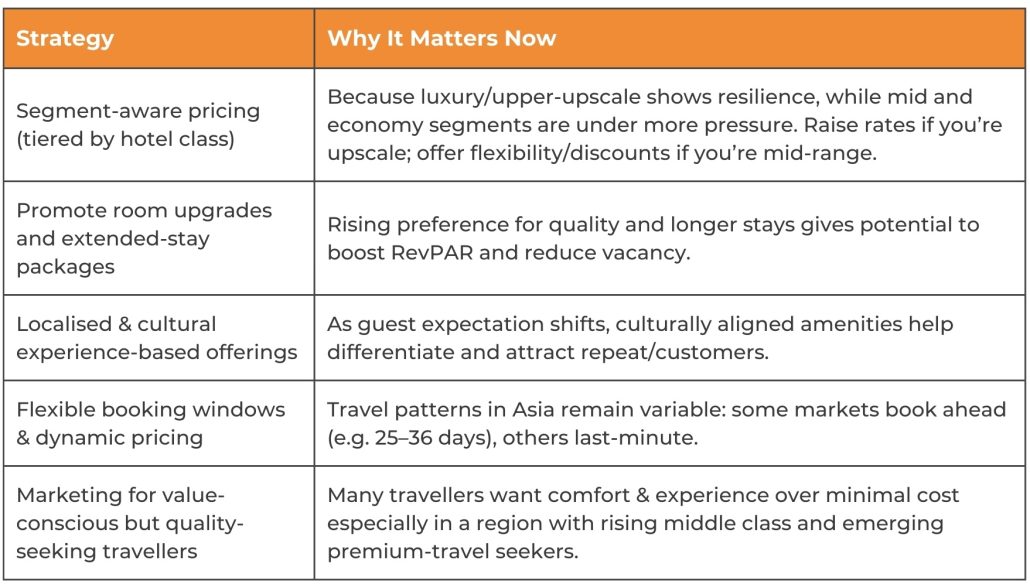
What It Means for Revenue Management & Hotel Strategy (for Q4 / Year-End)
Risks & What to Watch Out For
1) Segment Imbalance: If you’re operating a mid- or economy-tier hotel, you may be squeezed by soft ADR and rate competition. Relying only on occupancy could hurt profitability.
2) Supply Growth Pressure: In many Asian markets new hotel supply and branded hotel expansions continue. More supply = higher competition, which puts pressure on mid-market hotels.
3) Changing Booking Behavior & Lead Time Uncertainty: Depends strongly on guest origin and purpose (business vs leisure). Dynamic pricing and flexible cancellation policies become critical.
Strategic Recommendations for Hoteliers (Especially Decision-Makers)
1) Review your segment positioning: upscale vs mid vs economy and adjust year-end rate-setting accordingly. If you’re upscale, consider tight occupancy controls + modest rate increases. If mid/economy, tighten costs, offer value-add deals or packages.
2) Design & promote “experience + culture” packages rather than just “room + bed.” Think wellness, local cuisine, cultural touches, extended-stay benefits, especially attractive for business travellers extending stays or long-stay leisure travellers.
3) Adopt dynamic pricing and re-evaluate booking window strategies. Use data to track where your bookings are coming from (local, regional, international) and how far in advance, then tailor pricing and promotions accordingly.
4) Focus on direct bookings & personalised experiences. With guest expectations rising for localisation and personalisation, hotel websites or loyalty programmes may yield higher value than generic OTA-driven traffic.
5) Watch supply trends and competitive positioning with many new developments and brand-expansions in Asia, staying relevant requires differentiation (experience, service, localisation, flexibility).

The notion of “year-end slowdown” is no longer universal across Asia. For many hotels especially in upscale, culturally-aligned, experience-first segments, Q4 presents a strategic sweet spot: a chance to salvage occupancy, maximise revenue, and build loyalty among travellers who value more than just a bed.
If you approach year-end with data-driven pricing, smart segmentation, and guest-centric offerings, the end of the calendar year can become one of your strongest quarters, not a cleanup week.